What Is a Homeschooler?
Two Books on Homeschooling - its Past, Present, and Future
by Sam Chesser
What is a homeschooler?
When asked this question, many people no doubt have a set image in their head. A large family. The mother stays home to teach the children. They come from a conservative religious background and are schooling their children at home due to a dissatisfaction of the moral climate of the school system. Predominately white. Those reading this review will probably have a broader view of homeschooling as it has become more popular and culturally relevant, but questions of definitions and cultural images persist.
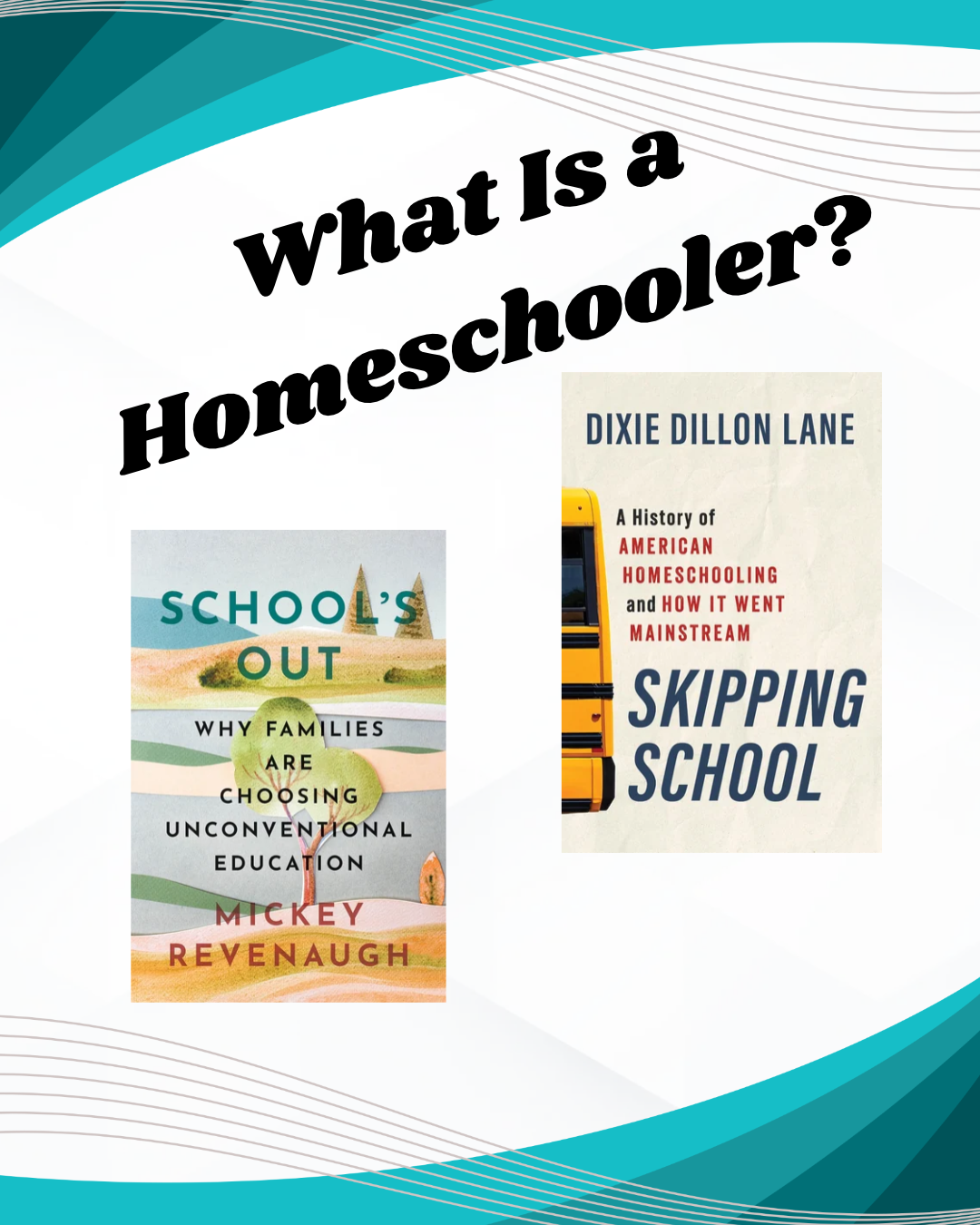
Into these dynamics come two sterling new books, Skipping School: A History of American Homeschooling and How It Went Mainstream by Dixie Dillon Lane and School’s Out: Why Families Are Choosing Unconventional Education by Mickey Revenaugh. Both books attempt to complicate our narratives, not only of what homeschooling is in 2026, but also how we got to this point. Both also attempt to extrapolate where homeschool may be going in the coming years.
Lane, a homeschool parent herself with a PhD in history from Notre Dame, is primarily interested in the development of homeschooling in the latter half of the twentieth century. She begins her narrative in the 1950s, a time period where homeschooling had no official legal recognition and in which families had to either fight in court for their right to homeschool or keep their homeschooling secret. She observes this through the lens of two families, the Shinns and the Turners, whose fights for their right to homeschooling were ultimately unsuccessful and set a legal precedent ruling against homeschooling. She also addresses major education reformers such as John Holt and Raymond and Dorothy Moore.
From the start, Lane argues, the central issue at play in homeschooling was not religion, as is popularly imagined, but rather control. She asserts that in response to fears of Communism, many local communities surrendered authority to national government and technocratic experts, leaving parents with little to no influence over the decision at their children’s schools. She thus indicates that the uniting factor was a strain of anti-establishmentism, from conservative Christians who disapproved of the moral foundations of the teaching to left-wing concerns over the ideologies shaping the teaching.
In addition to the ideological diversity present from the beginning of homeschooling, Dillon highlights the African-American families who, frustrated with the crumbling inner-city schools their children faced, opted to take control of their children’s education. She also points out that while a popular cultural image is of the Evangelical Protestant homeschooler, a post-Vatican II decline in parochial schools (and the prohibitive costs of the remaining schools) led to a vibrant movement of Catholic homeschoolers.
For these early years, Lane relies primarily on the anecdotes of families who were homeschooling at the time, acknowledging that the legal jeopardy families who homeschooled faced makes it prohibitively difficult to collect data on homeschoolers for this time. That same legal jeopardy also made it difficult for any sort of homeschool movement to begin. While some families used resources such as the mailing list for John Holt’s “Growing Without Schooling” newsletter (continued today by his colleague Pat Farenga) to find like-minded families to form small groups, the movement remained scattershot for several decades.
This began to change in the 1980s, particularly with the formation of the Home School Legal Defense Association (HSLDA). As more homeschooling families banded together, there was a greater hunger for a legal fight to codify the rights of homeschoolers, who were still in a legal grey area. Lane traces that fight for freedom, and sees the 1980s and 1990s as the decades where homeschooling became legally safe across the nation. Then, in the 2000s, it started to become more of a movement, with more defined curriculums and organizations.
Lane then takes her history into the 2010s and 2020s. She argues that during this period, homeschool began to become more mainstream. This process was already underway in the 2010s, but was sped up vastly in the 2020s during the pandemic. A variety of issues played out at this time. As children were forced to be at home, homeschooling became a logical choice for many families. Some saw their children’s education up close for the first time and didn’t like what they saw. Other parents were working from home for the first time, giving them necessary flexibility for homeschooling. While the homeschooling numbers have declined slightly from their pandemic highs, they remain significantly above pre-pandemic levels.
In contrast to Lane, Mickey Revenaugh, in School’s Out, does not primarily approach schooling from a historian’s lens. Instead Revenaugh, a cofounder of the platform Connections Academy, looks primarily from the lens of "edrepreneurs,” a class of people who are pioneering new ways of educating children, including microschools, unschooling, roadschooling, online schooling, and more.
Revenaugh is interested in complicating our narrative of what homeschooling is. In fact, homeschooling is a term not often used in the book, as the author is less interested in homeschooling as traditionally defined and more interested in alternatives to traditional educational models such as public schools, private schools, and charter schools. She situates her book in the present, where many innovators are rethinking what school can look like. To do so, she embeds herself in various communities to report on what’s occurring within them. One of Revenaugh’s biggest strengths is her ability to make these communities come alive, bringing to the forefront the excitement of those communities as they pursue individually tailored educational experiences.
Like Lane, Revenaugh seeks to demonstrate that homeschooling is a far more diverse place that exists in the popular imagination. She points to several schooling locations which cater to minority participants, not only in their enrollment but in their educational material, utilizing Black and Latino history materials to broaden the children’s knowledge and appeal to their interests. Revenaugh also shows the refuge that alternative education can provide to queer families in difficult times.
One of Revenaugh’s major interests is in the funding of these programs. She spends a good deal of time talking about Education Savings Accounts (ESAs) and the ways in which this funding can offer greater opportunity equality to families from diverse economic backgrounds. She does demonstrate that there have been difficulties in the institution of these funds, and the possibility of funding shortfalls in the future if homeschooling begins to rise, but also makes it clear that for alternative education models to thrive, it will require a mixture of public policy, private innovation, and family support.
Lane is somewhat more circumspect on the possibilities of ESAs and other sources of government funding. She highlights that homeschooling, by its very nature, has an inherent distrust of institutions, and there are well-founded fears of government regulation and strings attached to potential funding. Both authors also point out that there is still much controversy about what ESAs are allowed to pay for, as well as the potential inflationary possibilities of more money injected into the system.
Hanging over both books is the question of where homeschooling goes from here. Revenaugh appears to be optimistic about the future. She argues that we could very well be approaching Malcolm Gladwell’s idea of “the tipping point,” the time when an idea becomes fully established and mainstream. She notes that post-pandemic there is a great hunger for alternate educational opportunities, and technology is making those opportunities scalable at a larger level. She does, however, note that policy changes will be necessary, including “frictionless processes for establishing and enrolling in alternative learning choices, help for families in navigating this brave new world, and especially universal availability of funding mechanisms like ESAs and tax credits.”
Lane is somewhat more hesitant in her optimism. While she acknowledges the clear growth and acceptance of homeschool, she notes that the movement has had both advances and setbacks in the past, and worries that the future could hold more setbacks, particularly in light of high profile works like Tara Westover’s Educated and the television program 19 Kids and Counting, both of which showed America a darker lens into the homeschooling world. Lane also reflects a sense of pessimism among long-term homeschoolers and second generation homeschoolers, many of whom feel that homeschooling at its core is a grassroots movement, and that ESAs and the growing popularity of homeschooling has led to a crisis in identity, where there is little cohesion or common sense of purpose.
Wherever homeschooling is going, both books make clear that this is a crucial time in the history of homeschooling, and that decisions made in coming years may completely redefine what it even means. Both books are an excellent window into where the movement has come from, where we stand now, and what the future holds.
Share Article
Discover More